City of Kirby, Texas News
Who Wanted Kirby’s Bonds? Inside the $161.6 Million Investor Order Book
Thirty-one accounts submitted nearly 11 times more orders than Kirby had bonds to sell. The demand helped lower borrowing costs—but it did not make investors owners of the city.
Kirby’s A+ rating established its credit story and the City Council authorized the borrowing. The investor order book provided a third test: whether the municipal market would actually compete to finance the city. It did—decisively.
The City of Kirby entered the municipal market with $14.89 million in Combination Tax and Revenue Certificates of Obligation. By the end of pricing, investors had submitted approximately $161.59 million in orders.
That does not mean the city borrowed $161.59 million. It means demand for the available securities greatly exceeded supply. According to the Hilltop Securities presentation delivered to the City Council, the oversubscription allowed interest rates on individual maturities to be lowered by 2 to 12 basis points and reduced the proposed true interest cost by approximately 11.6 basis points.
For residents, this is the most practical meaning of investor demand: competition among buyers helped Kirby obtain better pricing. The buyers were not bringing private development rights, management authority or a claim on City Hall. They were competing to lend money to the city under the terms of the bond documents.
Two categories accounted for nearly two-thirds of demand
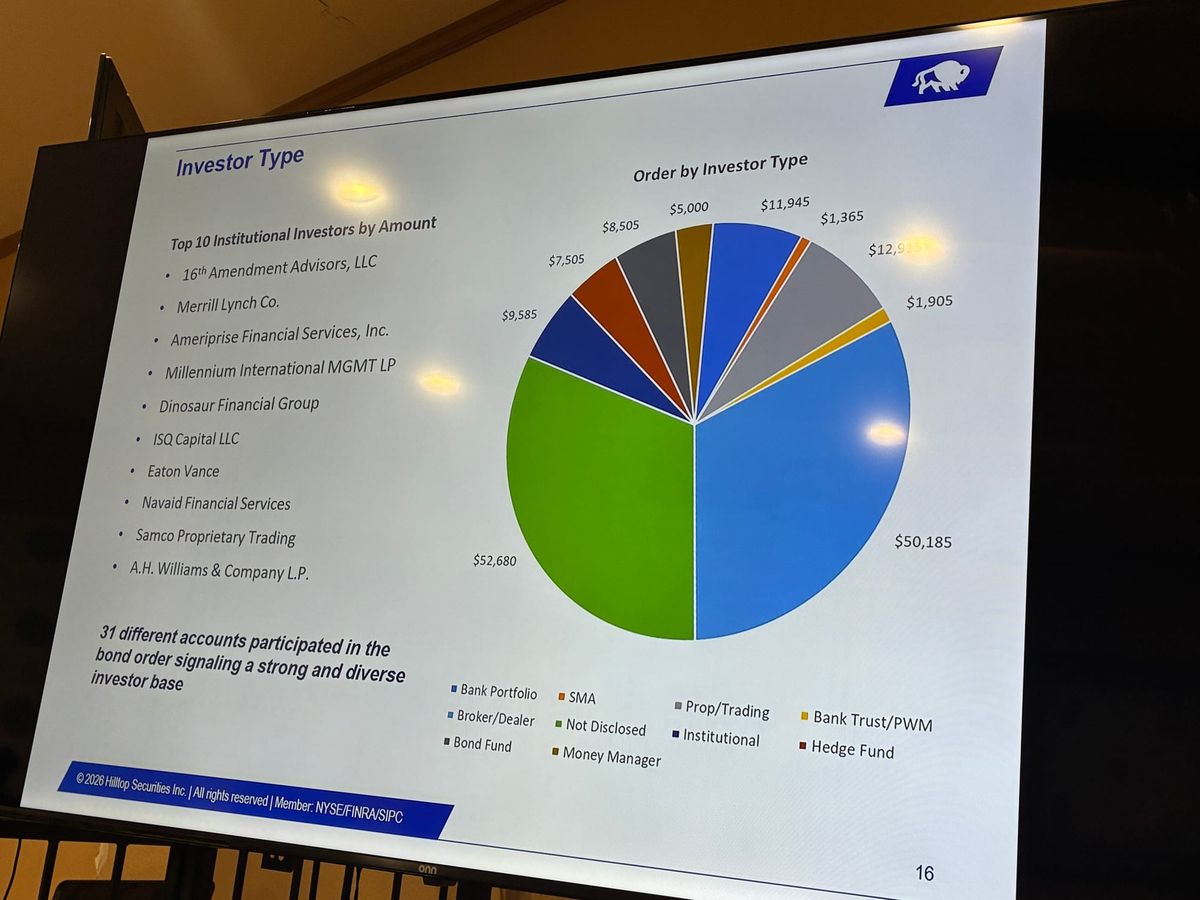
The investor-type slide divides the $161.59 million order book into ten account categories. “Not disclosed” was the largest category at approximately $52.68 million, followed closely by broker-dealers at approximately $50.19 million.
Together, those two categories represented about 63.7% of all reported orders. The “not disclosed” label does not mean the buyers were unknown to the underwriters. It means their category or identity was not disclosed in the public presentation.
The mix matters because it shows demand did not come from a single buyer or one corner of the market. Banks, broker-dealers, professional money managers, funds, private-wealth channels and trading accounts all appeared in the book.
Who the listed financial firms are—and what the list does not prove
Hilltop’s slide identified the following “Top 10 Institutional Investors by Amount.” The public presentation did not state the size of each firm’s order, the bonds ultimately allocated to each account or whether any account later sold its position.
| Firm named on slide | What the firm is known for | What can be concluded here |
|---|---|---|
| 16th Amendment Advisors, LLC | A New York registered investment adviser focused exclusively on municipal bonds, operating with affiliated 16Rock Asset Management. | The name reflects specialized municipal-market demand; the slide does not disclose its final allocation. |
| Merrill Lynch Co. | A major brokerage and wealth-management platform serving individual and institutional clients. | The order could represent a platform, trading desk or client account; the slide does not identify the beneficial owner. |
| Ameriprise Financial Services, Inc. | A financial-advice, brokerage and investment-advisory business. | The listed name indicates an order channel, not proof that Ameriprise itself retained the bonds. |
| Millennium International MGMT LP | Associated with Millennium, a global diversified alternative-investment firm. | It demonstrates interest from a sophisticated alternative-investment account; allocation is not shown. |
| Dinosaur Financial Group | A FINRA-registered full-service broker-dealer with sales and trading capabilities. | The firm may have acted for its own account or a customer; the public slide does not say which. |
| ISQ Capital LLC | The presentation names the account but supplies no business description. Texas Capital Report did not identify a sufficiently clear primary source to characterize the exact entity. | No conclusion should be drawn beyond the fact that an account under this name appeared in the order presentation. |
| Eaton Vance | An established asset-management name with a large municipal-bond team and a broad range of municipal strategies. | The slide does not identify which Eaton Vance fund, strategy or client account submitted the order. |
| Navaid Financial Services | A FINRA-regulated brokerage firm and longtime Municipal Securities Rulemaking Board registrant. | The slide records an order name, not the final amount held after allocation. |
| SAMCO Proprietary Trading | An affiliate formed to trade municipal bonds; the wider SAMCO organization is known for municipal underwriting, trading and public finance. | This is the clearest example of a proprietary-trading account in the named list. |
| A.H. Williams & Company L.P. | An investment manager specializing in tax-exempt and taxable municipal securities. | Its appearance is consistent with demand from a municipal-bond specialist. |
Three stages that should not be confused
An account requests a dollar amount during pricing. Orders may exceed the amount available and may later be changed or withdrawn.
The underwriting team decides how much of each maturity an account receives. A large order may receive only a partial allocation—or none.
After closing, bonds can trade in the secondary market. The holder today may not be the account that ordered during the original sale.
This distinction is especially important when a broker-dealer or wealth platform appears by name. That firm may be purchasing for inventory, for an affiliated fund, for an adviser-managed account or on behalf of customers. The public slide does not reveal those underlying relationships.
Municipal bondholders also do not obtain a vote in Kirby government. Their legal rights concern repayment and the protections contained in the certificates and transaction documents. Kirby’s elected officials still set policy, city management still administers operations and residents still hold the city accountable.
Credit quality, insurance, yield and scarcity worked together
The order book should not be read as an endorsement of every city policy or every project. Professional buyers evaluate securities, not campaign platforms. Kirby’s offering combined several features that can make municipal debt attractive:
What buyers could evaluate
- Kirby’s A+ underlying S&P credit rating with a stable outlook.
- Assured Guaranty insurance that reportedly allowed the bonds to be marketed with an AA rating.
- A maturity schedule extending from 2027 through 2056.
- Yields ranging from 2.65% on the earliest maturity to 4.73% on the longest maturities.
- A security pledge supported by ad valorem taxes and limited surplus utility revenues under the financing documents.
What the order book does not prove
- That every listed account ultimately received bonds.
- That every original buyer still holds the securities.
- That investors approved every project the city may finance.
- That Kirby faces no future budget, tax or execution risk.
- That market demand replaces public oversight of how proceeds are spent.
Bond insurance also mattered. The city’s presentation estimated that insurance reduced the true interest cost by approximately seven basis points, with projected savings greater than the $49,881 premium. The insurance did not erase Kirby’s underlying obligations. It added a guarantor and gave investors another layer of payment protection.
Strong demand converted directly into lower borrowing costs
Kirby’s final transaction carried a reported true interest cost of 4.49%, compared with a 5.20% projection presented on May 15. The proposed structure also delivered $15 million to the project fund while reducing the bond principal to $14.89 million.
Projected aggregate debt service fell from $29.66 million in the May presentation to approximately $27.71 million in the final proposal—a reduction of about $1.95 million. Not all of that improvement can be attributed to the order book alone; changing interest rates, structure, premium, insurance and market timing also shaped the result. But the underwriter explicitly reported that investor competition enabled additional yield reductions during pricing.
Kirby’s first test was whether its finances could support an A+ credit rating. The second was whether a council majority would authorize the debt. The third was whether the market would buy it. Thirty-one accounts and a 10.8-times oversubscribed order book answered that question—but the next test is whether Kirby converts the borrowed capital into visible, durable and fully documented public improvements.
The investor names and account-type totals in this article come from Hilltop Securities slides presented during the July 9, 2026 Kirby City Council meeting and photographed by Christopher C. Herring. The slides show orders during initial pricing, not a final allocation report or a current list of beneficial bondholders.