New US Veteran Stability Index (VSI) Shows Where Veterans May Find the Best ZIP Codes for Living...
How the Veteran Stability Index works Economic Stability 25% · Employment Stability 20% · Housing Stability 20% · Health & Service Access 15% · Mobility & Practical Access 10% · Community Support 10%. Public ranking requires at least 250 Veterans and complete core components.

Texas Has a New Veteran Stability Map — and Military City USA Has a More Complicated Story
The National Data System’s new Veteran Stability Index ranks core-complete ZIP codes on economic, employment, housing, health and service access, mobility and community support. North Texas and Austin dominate the top of the Texas list, while San Antonio’s results reveal why a famous military identity does not make every neighborhood equally stable for Veterans.
Texas has long marketed itself to Veterans through a familiar vocabulary: jobs, land, military installations, no state individual income tax, warm weather and a culture that is comfortable around uniforms. San Antonio has gone further, turning “Military City USA” into part civic identity, part economic-development strategy and part shorthand for a metropolitan area shaped by generations of service members and military families. But the newest National Data System analysis asks a different question, one that is more intimate than whether a city is military-friendly: What does the ZIP code itself look like for a Veteran who has to live there, pay for housing there, find work there, travel to care there and rely on the institutions around them?

The National Data System’s newly certified Veteran Stability Index, or VSI, is an attempt to answer that question at ZIP-code scale. Developed by a Veteran, the index scores qualified Veteran communities on six dimensions: Economic Stability at 25 percent, Employment Stability at 20 percent, Housing Stability at 20 percent, Health and Service Access at 15 percent, Mobility and Practical Access at 10 percent and Community Support at 10 percent. The current certified release, VSI V1.0.8, began with 33,772 Veteran ZIP records, applied a minimum threshold of 250 Veterans, and ultimately ranked 13,541 ZIP codes with complete core components. Another 141 ZIPs met the Veteran-population threshold but were held out because they lacked one or more required core inputs. In other words, the index does not turn missing information into a bad score. It ranks communities only when the underlying evidence is sufficient.
That matters because VSI is not a measure of patriotism, military tradition or even the size of the local Veteran population. A ZIP can be home to thousands of Veterans and still face economic, housing or transportation pressure. Another ZIP can be far from a major active-duty installation yet offer an unusually stable mix of income, employment, housing and services. The score is therefore best read as a warning-and-opportunity signal: higher values indicate a stronger combination of conditions for Veterans; lower values point to areas where one or more parts of daily life may be under pressure. The public tiers are relative national bands. “Strong Stability” means a ZIP is in the top national decile among qualified, core-complete Veteran communities, not that every household in the ZIP is secure or that no Veteran faces hardship.
Texas performs well at the top, but the geography is not evenly distributed. The highest-ranked Texas ZIP in the certified release is 75054 in Grand Prairie, with a VSI of 74.96, a national rank of No. 285 and a national percentile of 97.9. Richardson’s 75081 follows with a score of 74.32, while Flower Mound’s 75022 ranks third in Texas at 73.56. Amarillo’s 79119 is fourth at 73.37. Another Flower Mound ZIP, 75028, is fifth at 73.21. All of the top 25 Texas ZIPs fall in the national Strong Stability tier, with even the 25th-ranked Texas ZIP, Austin’s 78759, still above the 93rd national percentile.
Top 10 Texas ZIP Codes in the Certified NDS Veteran Stability Index
| TX Rank | ZIP | Community | VSI | National Rank | National Percentile |
|---|---|---|---|---|---|
| 1 | 75054 | Grand Prairie | 74.96 | #285 | 97.90th |
| 2 | 75081 | Richardson | 74.32 | #348 | 97.44th |
| 3 | 75022 | Flower Mound | 73.56 | #426 | 96.86th |
| 4 | 79119 | Amarillo | 73.37 | #447 | 96.71th |
| 5 | 75028 | Flower Mound | 73.21 | #460 | 96.60th |
| 6 | 76655 | Lorena | 73.21 | #461 | 96.60th |
| 7 | 75048 | Sachse | 73.19 | #463 | 96.58th |
| 8 | 78681 | Round Rock | 72.32 | #576 | 95.75th |
| 9 | 78732 | Austin | 72.27 | #585 | 95.69th |
| 10 | 76034 | Colleyville | 72.24 | #590 | 95.65th |
The map is striking. Fourteen of the Texas top 25 ZIPs sit in the broader Dallas–Fort Worth orbit. Seven are in Austin or Round Rock. Two are in the Waco area. One is in Amarillo. One is in San Antonio. That distribution is a useful rebuke to the assumption that the best Veteran environment must be the place with the largest base, the most uniforms or the loudest military brand. The strongest Texas results are heavily suburban and exurban: Grand Prairie, Richardson, Flower Mound, Sachse, Colleyville, Roanoke, Irving, Carrollton, Keller, Argyle and Aledo all appear. Austin’s high-performing cluster includes Round Rock and several western and northwestern ZIPs. These are places where the index is picking up a broad mix of household stability, employment opportunity, housing conditions, mobility and institutional capacity.
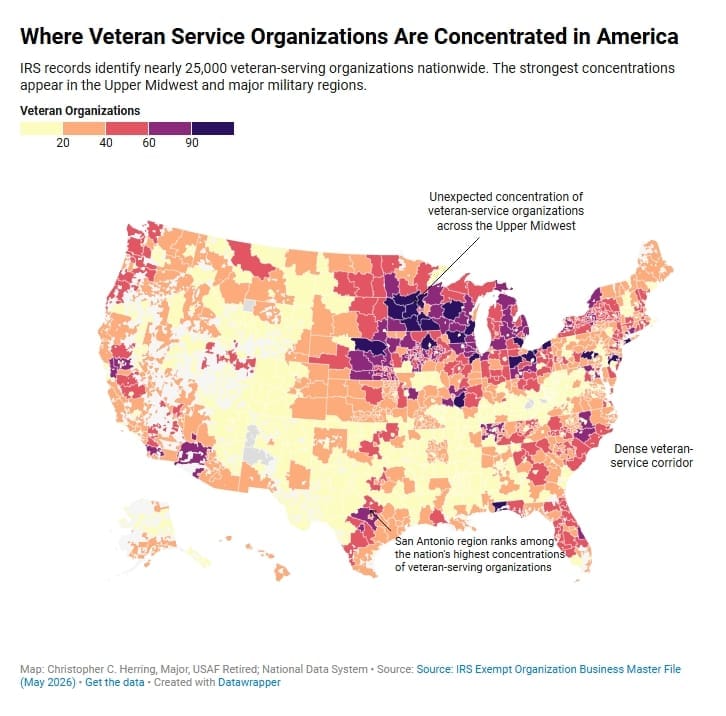
San Antonio is where the story becomes more complicated — and more useful. Military City USA does not perform poorly. It performs unevenly. NDS identified 59 San Antonio city-labeled Veteran ZIP rows, of which 53 met the full certification requirements for ranking. Their average VSI is 49.42 and the median is 50.11. The city’s strongest ZIP, 78248, reaches 70.76, good for No. 22 in Texas and No. 835 nationally. At the other end of the city’s certified range, 78207 scores 29.96. That is a swing of more than 40 VSI points inside a single military-centered metropolitan area. For a Veteran deciding where to rent, buy, retire, raise a family or start a second career, that spread is more meaningful than the citywide nickname.
San Antonio’s highest‑ranked ZIP codes are clustered in the city’s most familiar northside and Hill Country‑edge communities — the areas known for strong schools, stable neighborhoods, and easy access to shopping, medical care, and outdoor space.
At the top is 78248, covering the Far North and Shavano Park area, long recognized for its mix of established neighborhoods and high household stability. Close behind is 78259, the Stone Oak / Canyon Springs corridor, followed by 78231 in Castle Hills / North Central, and 78266, which includes Garden Ridge and the Hill Country edge.
Top 10 Texas ZIP Codes in the Certified NDS Veteran Stability Index
| TX Rank | ZIP | Community | VSI | National Rank | National Percentile |
|---|---|---|---|---|---|
| 1 | 75054 | Grand Prairie | 74.96 | #285 | 97.90th |
| 2 | 75081 | Richardson | 74.32 | #348 | 97.44th |
| 3 | 75022 | Flower Mound | 73.56 | #426 | 96.86th |
| 4 | 79119 | Amarillo | 73.37 | #447 | 96.71th |
| 5 | 75028 | Flower Mound | 73.21 | #460 | 96.60th |
| 6 | 76655 | Lorena | 73.21 | #461 | 96.60th |
| 7 | 75048 | Sachse | 73.19 | #463 | 96.58th |
| 8 | 78681 | Round Rock | 72.32 | #576 | 95.75th |
| 9 | 78732 | Austin | 72.27 | #585 | 95.69th |
| 10 | 76034 | Colleyville | 72.24 | #590 | 95.65th |
The numbers also help explain what San Antonio’s military brand gets right — and what it can hide. Compared with Amarillo, San Antonio scores much higher on average Community Support: 56.35 versus 41.01. That fits the lived reality of a metropolitan area dense with Veteran institutions, military networks, service organizations and a public culture built around military families. But San Antonio trails Amarillo on average Employment Stability by 12.17 points and on Mobility and Practical Access by 15.80 points. Its Economic Stability average is 4.60 points lower and its Health and Service Access average is 7.50 points lower. Housing is essentially a tie. The lesson is not that Amarillo is “more military” than San Antonio. It is that military identity and community stability are different things. San Antonio’s institutional depth is a strength; its neighborhood-level economic, transportation and housing realities still vary substantially.

The contrast between San Antonio’s 78248 and Amarillo’s 79119 shows how different strengths can shape the feel of a community. Both ZIP codes score well, but for very different reasons. In 78248, economic and employment stability run high, with scores in the low‑80s. Amarillo’s 79119 matches that strength but flips the profile: its housing market is steadier, and its mobility score is one of the strongest in the state.
On health and access to services, the two ZIPs are almost identical. What separates them is geography. Amarillo’s nearest military installation is nearly 90 miles away, while 78248 sits just 14 miles from its closest base. For Veterans, that difference can change everything — commute times, access to care, daily routines, and the overall cost of staying connected to military and VA resources.
The takeaway is simple: strong communities don’t all look the same. Some offer stability through housing and mobility, others through economic strength and proximity to military life. The index highlights those differences so Veterans can see the full picture of what living in each place actually feels like.

For Veterans thinking about a move to Texas, momentum matters. The state is growing quickly, and some counties are seeing surges that reshape housing markets and daily life. In Bexar County, for example, recent migration data shows more than 37,000 new residents arriving in the latest cycle — a sign of just how much pressure is building in the same communities where Veterans may be searching for homes.
That number doesn’t tell us how many of those newcomers are Veterans, but it does highlight a reality: the neighborhoods Veterans are considering are the same ones attracting the most people overall. More residents mean tighter housing inventory, faster‑moving listings, shifting commute patterns, and rising demand near military bases and VA facilities.
For Veterans weighing proximity to medical care, comparing commute times, or deciding whether a higher housing cost is worth being closer to military and VA infrastructure, these migration waves are part of the real picture. Texas isn’t slowing down — and understanding where people are moving helps Veterans make clearer, more confident choices about where to live.
That is why VSI is potentially most useful as a relocation tool rather than as a simple ranking. A Veteran moving from another state may know that San Antonio has Joint Base San Antonio, a deep military culture and a large Veteran population. VSI adds the next question: Which San Antonio ZIP offers the best balance for the life that Veteran actually plans to live? Someone prioritizing community support may accept a different trade-off than someone prioritizing mobility, housing or employment. A retired Veteran may weight practical access differently from a 35-year-old Post-9/11 Veteran entering a second career. A family may care about housing stability and commute burden more than raw proximity to an installation. The index does not make the decision. It makes the trade-offs visible.

Texas’ top list also suggests that relocation marketing aimed at Veterans should broaden its map. North Texas and Austin-area suburbs are emerging as strong Veteran-stability environments even when they are not the first places associated with military life. Grand Prairie’s 75054, Richardson’s 75081 and Flower Mound’s 75022 all place ahead of every San Antonio ZIP in the current certified release. Round Rock’s 78681 and Austin’s 78732 are also in the Texas top 10. For economic-development officials, homebuilders, employers and local governments, that creates a new question: Are these ZIP codes intentionally serving Veterans, or are Veterans benefiting incidentally from conditions that are already strong for the broader population? The answer could influence workforce recruitment, housing policy, nonprofit strategy and the location of Veteran-focused services.
For San Antonio, the stakes are slightly different. Military City USA already has the brand. What VSI gives it is a neighborhood-level accountability test. The city can now see where its Veteran ecosystem is translating into broad stability and where the benefits of that ecosystem are not keeping pace with economic hardship, housing instability or mobility pressure. The city’s strongest Veteran ZIPs are not an argument for complacency, and its weakest are not a verdict against San Antonio. Together they show why a citywide military identity can coexist with sharply different day-to-day realities from one ZIP code to the next.
The larger significance of VSI is that it turns the Veteran relocation conversation away from slogans and toward evidence. Texas remains a compelling destination for many Veterans, but “move to Texas” is not specific enough to be useful. The real decision is Dallas–Fort Worth or Austin, Amarillo or San Antonio, and then one ZIP against another. NDS is now measuring that choice with the same geographic discipline it applies to migration, housing, nonprofit capacity, employment and access. For Veterans, the value is not in finding a perfect ZIP. It is in knowing what kind of stability a ZIP appears to offer before the moving truck arrives.
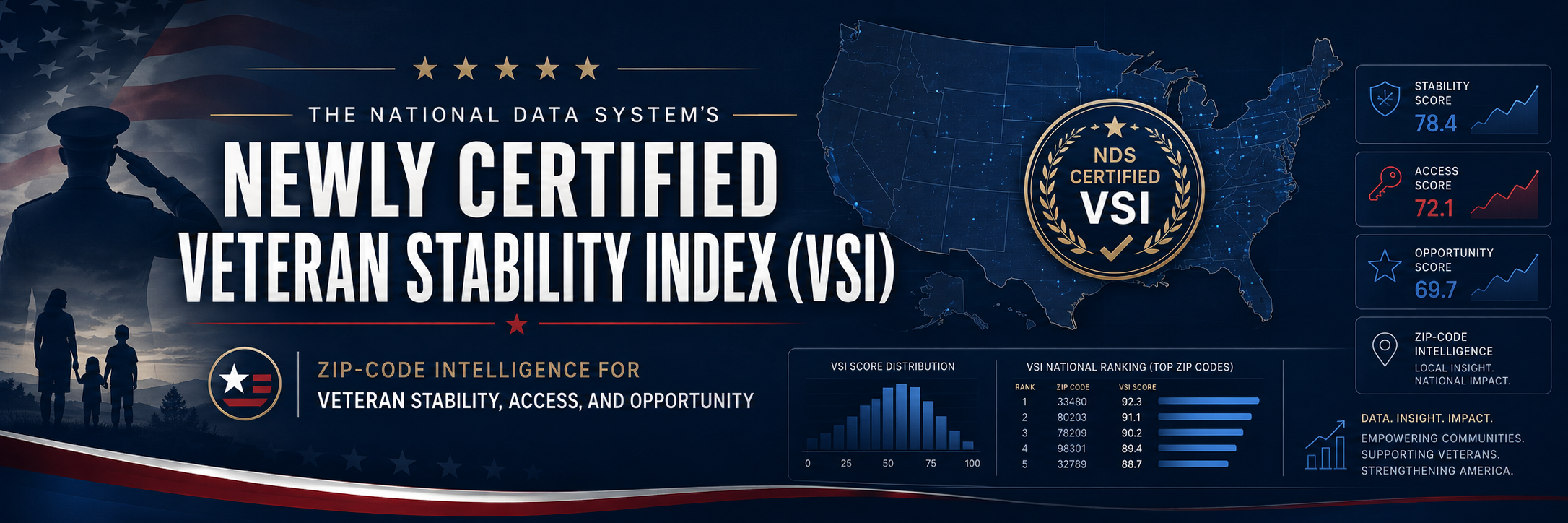
How the Veteran Stability Index works
Economic Stability 25% · Employment Stability 20% · Housing Stability 20% · Health & Service Access 15% · Mobility & Practical Access 10% · Community Support 10%. Public ranking requires at least 250 Veterans and complete core components. Strong Stability is the top national decile among qualified, core-complete ZIPs.
Data note: Veteran Stability Index figures are from National Data System certified VSI V1.0.8. NDS migration context comes from the IRS Migration backbone and related NDS county/ZIP intelligence. IRS migration records describe tax-return migration and do not identify Veteran status. NDS public area labels are descriptive geography intended to make ZIP-level intelligence easier to read. VA hospital-distance detail is supplementary to the broader VA medical-facility access layer and should not be read as a complete inventory of all local VA care.