Why America's Strongest Veteran Support Networks May Not Be Where You Think
Counties across Wisconsin, Minnesota, Iowa, Illinois, and neighboring states display some of the highest concentrations of veteran-service organizations in the nation.

By Christopher C. Herring
When most Americans think about veteran communities, they think about military installations.
Places like San Antonio, Texas. Norfolk, Virginia. Jacksonville, Florida. and Colorado Springs, Colorado stand out.
These cities have earned their reputations through decades of military service, active-duty personnel, veterans, retirees, and defense-related institutions.
But a new analysis of Internal Revenue Service nonprofit records reveals something unexpected.
The strongest concentrations of veteran-service organizations in America are not found exclusively around major military installations. Instead, some of the nation's most concentrated veteran-support ecosystems appear across the Upper Midwest.
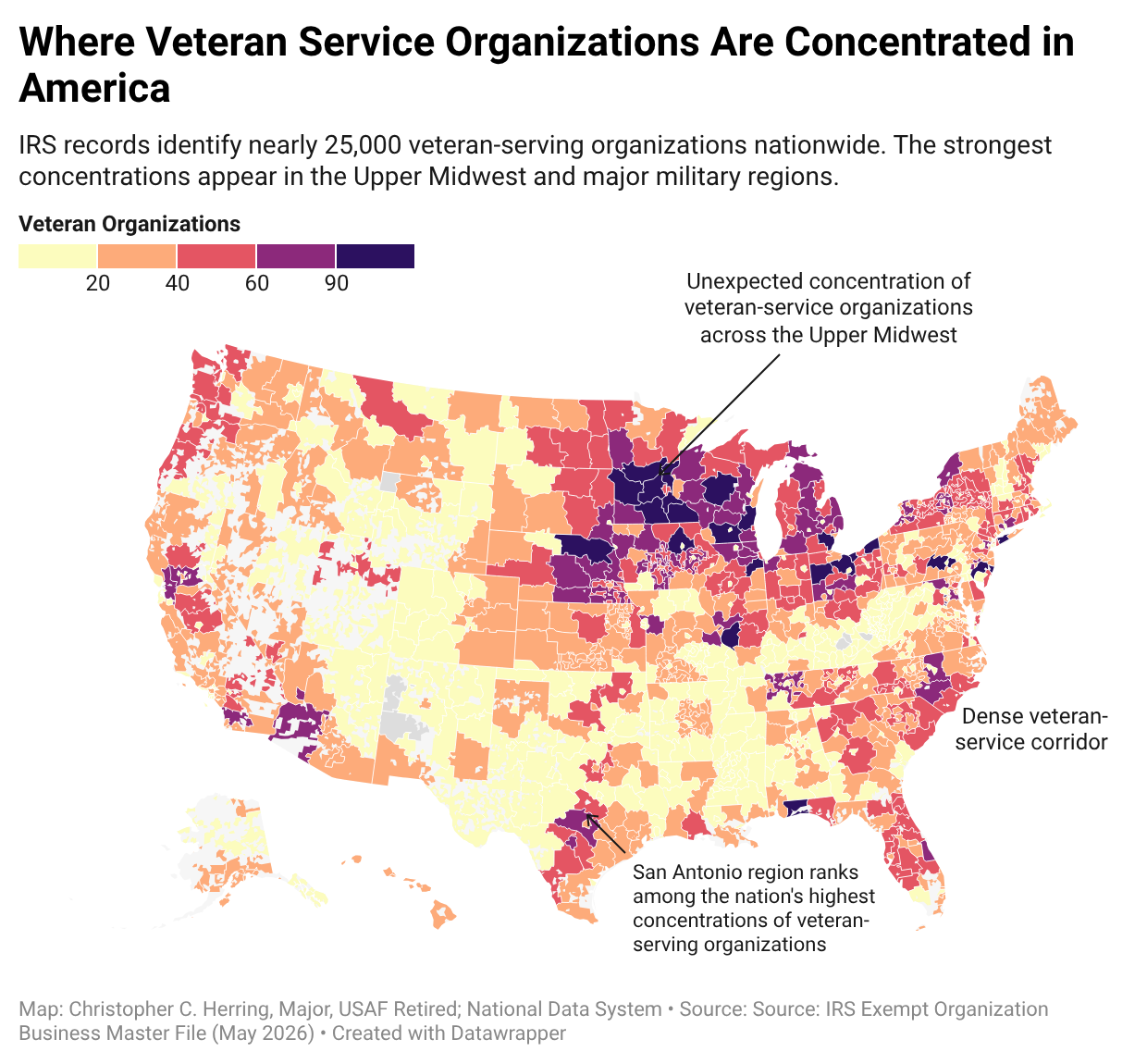
Using the Internal Revenue Service Exempt Organization Business Master File, NationalDataSystem identified nearly 25,000 veteran-serving organizations operating across the United States. The organizations include veterans groups, military support organizations, community-based veteran nonprofits, and other exempt organizations classified under veteran-serving categories.
The resulting map highlights several expected regions. South Texas stands out, reflecting the long-standing influence of Joint Base San Antonio and the city's identity as Military City USA. Portions of Virginia and the Mid-Atlantic corridor also show elevated concentrations of veteran-serving organizations, consistent with the military footprint surrounding Norfolk and related installations.
The surprise emerges farther north.
Counties across Wisconsin, Minnesota, Iowa, Illinois, and neighboring states display some of the highest concentrations of veteran-service organizations in the nation. Unlike many military hubs, these communities are not primarily defined by active-duty military populations. Instead, they appear to represent mature veteran-support ecosystems built around local institutions, civic organizations, service clubs, American Legion posts, Veterans of Foreign Wars chapters, and community-based support networks.
The finding suggests that veteran support in America is not solely a function of military presence. It is also a function of community organization.
Military installations create veteran populations.
Communities create veteran support systems.
That distinction matters.
As policymakers debate veteran services, workforce development, housing assistance, healthcare access, and community resilience, the density of veteran-serving organizations may provide an overlooked indicator of local support capacity. Areas with strong nonprofit infrastructure may be better positioned to connect veterans with assistance, coordinate services, and sustain long-term community engagement.
The map also highlights a broader lesson about data.
Many assumptions about geography are shaped by visibility. Large military installations are easy to see. Community support ecosystems are harder to measure.
By examining nearly two million nonprofit records, patterns emerge that challenge conventional wisdom and reveal how civic institutions operate beneath the surface.
The result is a more complete picture of veteran support in America—one that extends beyond bases, uniforms, and military budgets to include the thousands of local organizations that help veterans navigate civilian life long after their service has ended.
In many cases, the strongest veteran-support systems may not be found where the military is largest.
They may be found where communities have spent generations building institutions that endure.