The Quiet Disappearance of America's Economic Memory
In an age increasingly driven by data, the greatest risk may not be that America lacks information—but that some of its most trusted public sources quietly fade away before anyone notices they are gone.

Federal budget cuts have quietly erased pieces of the nation's economic record, leaving researchers, businesses and communities with fewer tools to understand local economies.
By Christopher C. Herring
There are no flashing warning banners on the U.S. Bureau of Economic Analysis website. No press conference. No public debate. Instead, visitors searching for regional economic statistics encounter a brief notice announcing that selected state data tables were discontinued in September 2024, followed by selected county tables in November because of budget constraints. In just a few understated sentences, one of the federal government's most important economic data repositories acknowledges that information relied upon by economists, local governments, researchers and businesses is no longer being maintained in the same way.
It is the kind of announcement that many users will scroll past without a second thought. Yet for those who depend on these statistics to measure economic growth, compare communities or track regional change over time, it signals something far larger than a website update. It marks another step in the gradual erosion of the nation's public statistical infrastructure.
Only after that realization does a broader question emerge: What happens when America begins losing pieces of its own economic memory?
For decades, economists, journalists, city planners, entrepreneurs, and ordinary citizens have returned to the same government websites with quiet confidence. They were places of institutional permanence, digital libraries where America's economic story unfolded year after year through carefully maintained tables, maps, and statistics. Every update added another chapter to the nation's evolving narrative, allowing anyone—from a graduate student to a mayor—to measure growth, decline, prosperity, or hardship with the same trusted numbers.
Then, almost unnoticed, parts of that story began to disappear.
Visitors to the U.S. Bureau of Economic Analysis' Regional Data portal are now greeted not only by familiar tables measuring Gross Domestic Product, personal income, and regional economic performance, but also by an understated announcement that signals something far more consequential than a routine website update. Selected state data tables were discontinued in September 2024. Selected county tables followed in November, casualties of budget constraints. The notice occupies only a few lines on the page, yet its implications extend far beyond the website itself.
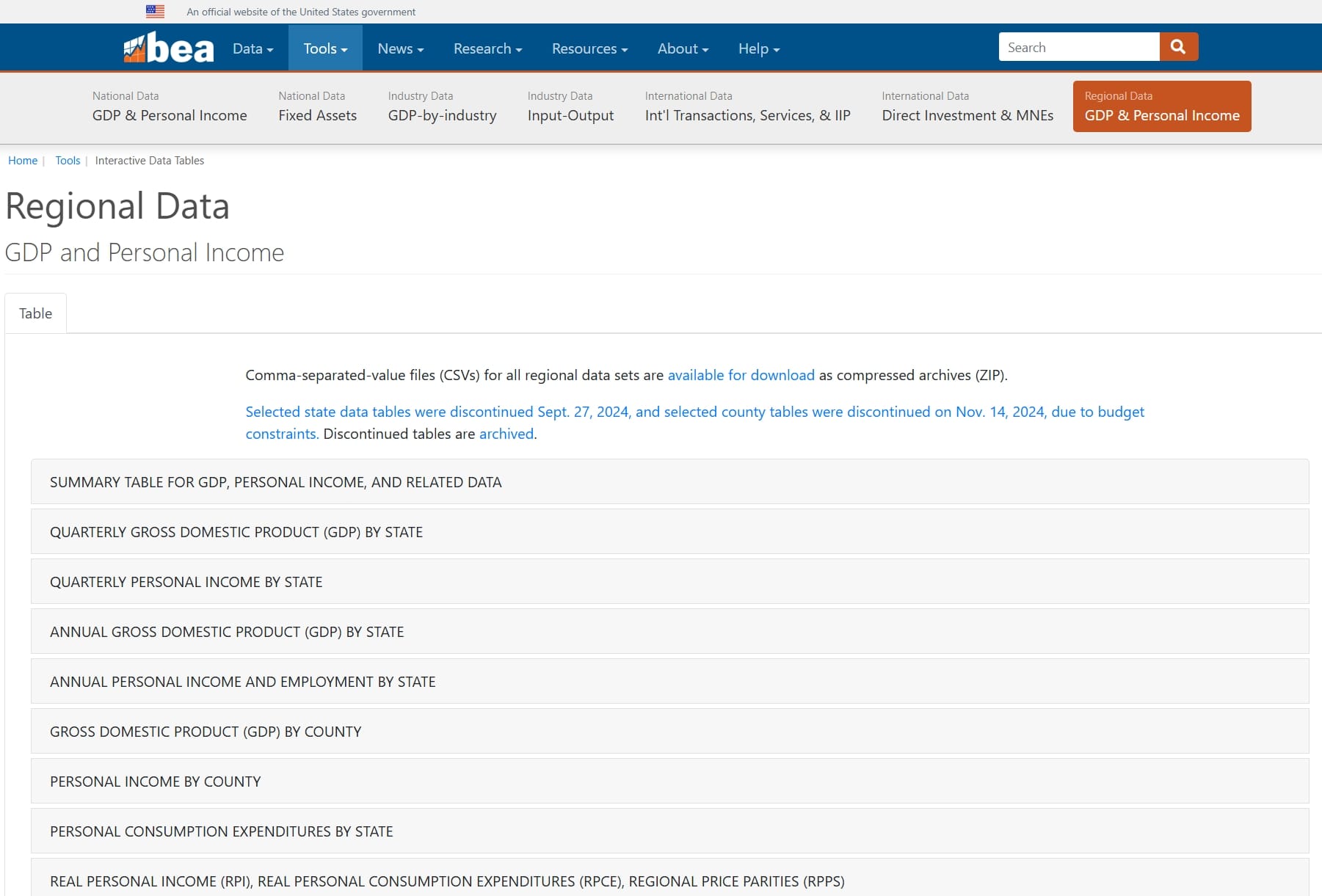
There are no flashing warnings. No dramatic headlines. Just a simple acknowledgment that some information Americans once considered permanently available has quietly moved into an archive—or vanished from routine access altogether.
That silence is precisely what makes it significant.
The Slow Erosion of Public Knowledge
Most people never think about economic statistics until they need them.
A business owner considering a new location may study regional income growth before signing a lease. A county commissioner may rely on historical GDP trends to justify infrastructure investments. Researchers compare decades of local economic performance to understand why one community flourished while another struggled. Journalists use the data to hold governments accountable. Investors measure opportunity. Families evaluate where to build their futures.
All of these decisions depend on one assumption: that the information will continue to exist.
When datasets disappear, the loss is rarely immediate. It arrives gradually, almost invisibly. Historical comparisons become more difficult. Automated systems break. Research projects require additional workarounds. Local governments lose benchmarks that once helped justify grant applications and development strategies. Small communities—already operating with limited analytical resources—often suffer the greatest consequences because they lack the capacity to recreate what federal agencies once freely provided.
Data, unlike roads or bridges, does not leave potholes when it deteriorates.
It leaves blind spots.
A Different Kind of Infrastructure
America traditionally defines infrastructure through concrete and steel: highways, airports, rail systems, electrical grids.
Yet there is another infrastructure quietly supporting modern society.
Statistical agencies.
Government databases.
Public records.
Economic measurements.
These systems rarely receive public attention because, when functioning properly, they simply work. They provide continuity. They establish trust. They allow countless organizations to make decisions using a shared understanding of reality.
Without them, every institution begins building its own version of the truth.
That fragmentation carries costs measured not only in dollars but in confidence.
The Hidden Cost of Budget Cuts
Budget reductions often produce visible consequences: fewer employees, delayed projects, postponed construction.
Data reductions work differently.
The consequences emerge years later.
Researchers attempting to compare counties across time suddenly discover missing variables. Economic development agencies lose historical context. Universities redesign studies because datasets are no longer maintained. Local newspapers, already operating with shrinking resources, lose reliable public information needed for investigative reporting.
The disappearance of a spreadsheet may seem insignificant.
The disappearance of decades of comparable public knowledge is something else entirely.
An Era That Demands More Data, Not Less
The timing could hardly be more paradoxical.
Artificial intelligence now promises unprecedented analytical power. Businesses increasingly depend on predictive models. Cities pursue "smart" infrastructure. Investors seek neighborhood-level insights before deploying capital. Public officials are expected to justify decisions with measurable evidence.
Never has society demanded more data.
The irony is that while portions of the public statistical record are shrinking, the value of regional economic data has never been greater. A 2020 Bureau of Economic Analysis working paper illustrates exactly why these datasets matter.
Finding Published in 2020...

Yet some of the foundational public sources that made those analyses possible are becoming harder to maintain.
Private companies have stepped into this growing information gap, packaging proprietary datasets into subscription products that can cost thousands of dollars annually. While these services provide valuable analysis, they also shift access to knowledge away from the public domain and toward those able to pay.
The result is an emerging divide between information that remains public and information that becomes increasingly commercialized.
Why This Matters to Texas
Texas has become one of the fastest-growing economies in the United States, adding new residents, businesses, and infrastructure at a pace few states can match. Every legislative session, members of the Texas House and Senate debate billions of dollars for highways, water systems, workforce development, housing, rural broadband, childcare, higher education, and economic development incentives. Those discussions increasingly rely on objective measurements to determine where growth is occurring, where infrastructure is falling behind, and where taxpayer dollars can have the greatest impact. When portions of those measurements disappear, legislative debates do not stop—but the evidence supporting them becomes less complete.
The quiet discontinuation of selected regional datasets raises an important question for Texas policymakers: What happens when the public data needed to evaluate growth begins to shrink?
Economic development organizations use regional GDP and income statistics to recruit employers. Rural counties rely on comparable federal data to compete for grants and infrastructure funding. Universities study long-term economic changes to understand why some communities prosper while others struggle. Local governments use these same measurements to justify roads, utilities, and public investments.
When fewer federal benchmarks are maintained, lawmakers are left with fewer independent tools to measure whether public policies are producing the intended results.
Texas is particularly vulnerable because of its size and diversity. The economic conditions of the Permian Basin, the Rio Grande Valley, North Texas, the Gulf Coast, and the Hill Country differ dramatically. Reliable regional statistics allow legislators to move beyond statewide averages and understand where growth is occurring, where infrastructure is under pressure, and where public investment may have the greatest impact.
The irony is difficult to ignore. Texas continues to lead the nation in business recruitment and population growth while the public information used to measure that success becomes more limited. As private companies increasingly monetize economic data, the Legislature may eventually face a choice: rely more heavily on commercial analytics or invest in strengthening Texas' own public data infrastructure through partnerships with universities, state agencies, and regional organizations.
The disappearance of federal datasets is not simply a technical issue. It is a governance issue. Data informs appropriations, oversight, economic development, and accountability. Without trusted benchmarks, policymakers risk making billion-dollar decisions with less complete information than previous generations possessed.
For a state that prides itself on planning for growth, protecting access to reliable economic intelligence may prove just as important as building the highways, schools, and water systems that growth requires.
What Is Really Being Archived?
At first glance, the discontinued tables appear to represent little more than administrative housekeeping.
In reality, they reflect something much larger.
Public datasets preserve institutional memory.
They document how regions transformed after recessions. They reveal where industries emerged and where they disappeared. They capture the long-term economic evolution of communities across generations.
Every archived table is part of America's collective memory.
Every discontinued dataset narrows the lens through which future generations will study the nation's economic past.
A Quiet Reminder
The notice on the Bureau of Economic Analysis website is not an argument against fiscal discipline, nor does it suggest that every historical table can or should be preserved indefinitely.
It does, however, remind us that information itself is infrastructure.
Economic statistics do more than describe the country.
They help the country understand itself.
And in an age increasingly driven by data, the greatest risk may not be that America lacks information—but that some of its most trusted public sources quietly fade away before anyone notices they are gone.
The disappearance of a government dataset rarely makes front-page news. There are no ribbon cuttings when statistics are published and no public mourning when they quietly disappear. Yet every missing table narrows the nation's collective memory. Future researchers will know less about today's America than today's researchers know about the America of yesterday. In an era increasingly driven by artificial intelligence and data-informed decision-making, preserving public statistics is no longer simply a matter of record keeping. It is an investment in the country's ability to understand itself.