
"Ready to Win!" Luck, Location, or Volume? Why One San Antonio ZIP Code Sold Nearly $31 Million in Big Texas Lottery Winners
The lottery remains fundamentally a game of chance, but the geography surrounding where winning tickets are sold offers a compelling reminder that even games of luck leave measurable footprints across a city.

New analysis of Texas Lottery data shows a handful of San Antonio ZIP codes account for tens of millions of dollars in winning tickets—but the reasons may have more to do with geography and consumer behavior than luck.
By Christopher C. Herring
San Antonio, TX - "Ready to Win" is ultimately a story about optimism. Every winning ticket represents someone who believed tomorrow could be different. Whether purchased on the way to work, during a grocery stop, or while filling up at a neighborhood convenience store, each ticket reflects a small act of hope. Across San Antonio, the communities surrounding the city's highest-performing lottery retailers have faced different economic and educational realities, yet they continue to demonstrate resilience, hard work, and optimism. While the data cannot explain why individuals buy lottery tickets, it does reveal something equally interesting: where millions of dollars in winning tickets have been sold—and what those locations tell us about the way San Antonio works.
Walk into almost any convenience store in San Antonio and you'll find a display of brightly colored Texas Lottery tickets promising instant fortunes and life-changing jackpots. But while every ticket carries the same mathematical odds, where those winning tickets are ultimately sold tells a fascinating story about how people move, shop, and spend money across one of Texas' largest cities.
A new analysis of Texas Open Data lottery claim records reveals that San Antonio West Side retailers located in ZIP code 78228 have sold more than $30.9 million in lottery prizes of $10,000 or more, making it the city's highest-producing ZIP code for major lottery winnings. The rankings, based on winning claim records in which the ticket was sold by a retailer located within the ZIP code, place 78264 (Von Ormy area), 78237 (Las Palmas / West Side), 78251, (Far West Side or Alamo Ranch area) and North Central's 78247 among the city's strongest performers, with each generating tens of millions of dollars in large prize claims.
The retailer rankings reveal another layer of the story. While ZIP codes highlight the geography of lottery activity, individual retailers illustrate where that activity is concentrated. Among the most active locations were Potranco Food Mart in ZIP code 78251, HEB Food Store #623 in 78251, HEB Food Store #463 in 78247, Step N Go in 78228, Little Sam #3 in 78237, and HEB Food Store #235 in 78264. These businesses consistently appeared among the city's leading sellers of winning tickets, suggesting that customer traffic, retail volume, and convenient neighborhood access may play a larger role in producing winning claims than chance alone. Their locations span San Antonio's West Side, Far West Side, North Central, and southern gateway communities, reinforcing the conclusion that lottery ticket sales tend to cluster along major commercial corridors where thousands of residents, commuters, and visitors shop each day.
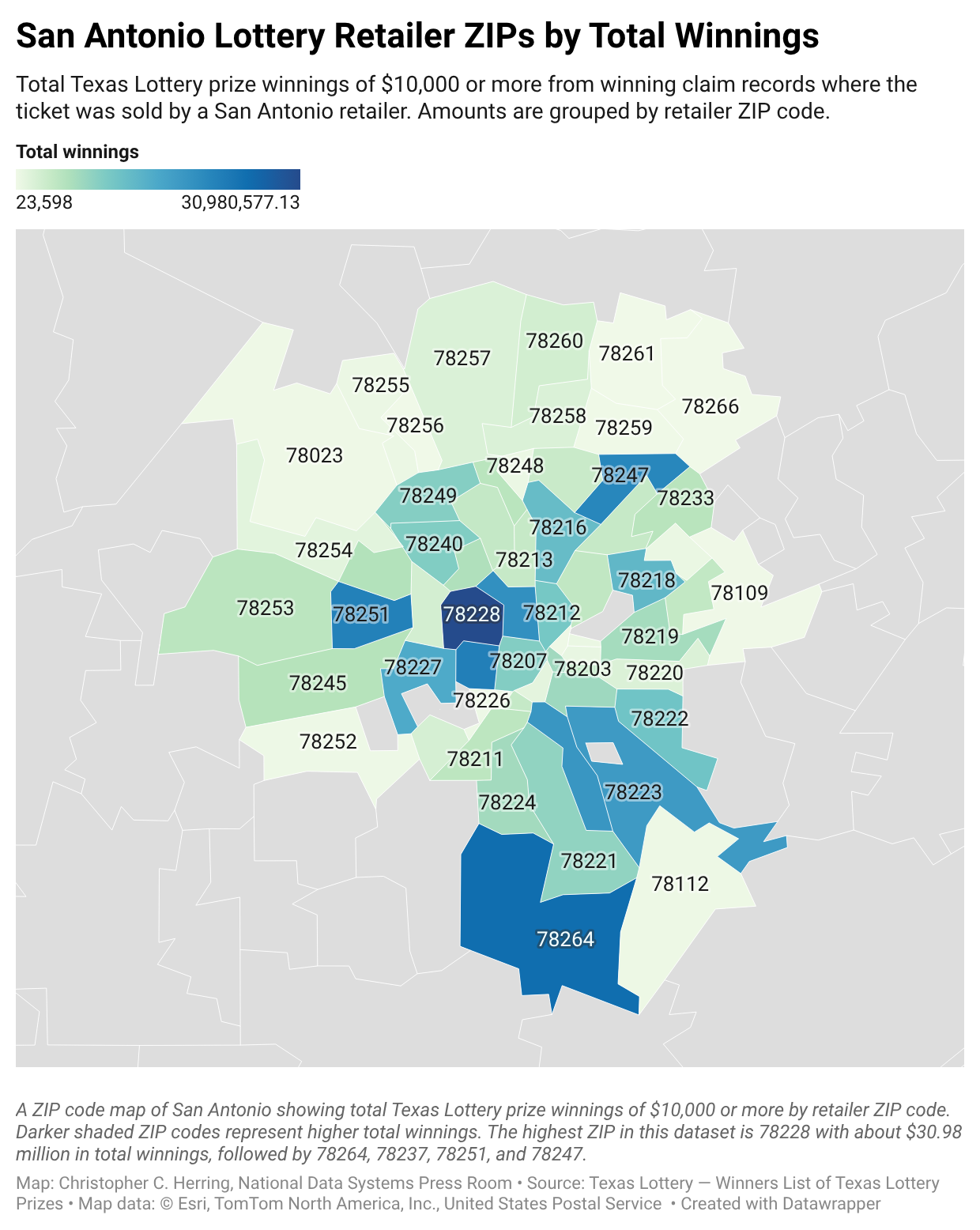
At first glance, the results appear to suggest extraordinary luck. But lottery researchers and economists have long cautioned against interpreting winning-ticket locations as evidence that one neighborhood is "luckier" than another. Retail ZIP codes reflect where winning tickets were purchased—not where winners live—and high-performing areas often coincide with major transportation corridors, large commercial districts, grocery stores, truck stops, and retail centers that simply sell far more lottery tickets than smaller neighborhood stores.
That distinction matters because the Texas Lottery records measure retailer activity, not community wealth or individual success. A commuter who buys a ticket while stopping for fuel on Interstate 10 or Loop 410 may live miles away from the store where the ticket was purchased. Popular shopping destinations can therefore accumulate disproportionately large prize totals simply because they attract customers from across the metropolitan area.
| Retailer | ZIP Code | General Area |
|---|---|---|
| Potranco Food Mart | 78251 | Far West Side / Potranco Corridor |
| HEB Food Store #623 | 78251 | Far West Side |
| HEB Food Store #463 | 78247 | North Central / NE San Antonio |
| Step N Go | 78228 | West Side |
| Little Sam #3 | 78237 | West Side / Las Palmas |
| HEB Food Store #235 | 78264 | Von Ormy / South Bexar County |
Taken together, these retailers function as regional commercial destinations rather than simply neighborhood convenience stores. Their recurring appearance among San Antonio's top lottery retailers suggests that winning-ticket distribution is influenced by sustained customer volume and purchasing activity across the metropolitan area. In that sense, the data measure commercial geography as much as lottery outcomes, providing a unique lens into how people move, shop, and participate in one of Texas' most visible consumer markets.
The concentration of high-value lottery sales also offers a unique glimpse into consumer geography. Unlike many economic indicators that measure where people live, lottery retail data reflects where people spend discretionary dollars. It highlights commercial hubs, traffic patterns, and purchasing behavior that often extend beyond neighborhood boundaries. In many respects, the map functions as both a map of retail activity and a map of opportunity—showing where thousands of people stop each day to work, shop, travel, and, occasionally, take a chance on changing their lives.
Unlike most demographic datasets that describe where people live, lottery retailer data reflects where people choose to spend money. That makes it an unusually powerful indicator of commercial geography, customer traffic, and regional shopping behavior.
Several of the highest-performing lottery ZIP codes sit in communities with long traditions of military service. Southside and Westside San Antonio have been home to generations of active-duty personnel, veterans, and military families connected to installations such as Kelly Field and other nearby defense facilities. That heritage has helped shape neighborhoods known for resilience, discipline, and public service—qualities that define these communities far more than any single economic statistic.
For policymakers like two Veterans - Texas State Rep Ray Lopez (HD125), and Representative Josey Garcia (HD124) - and State Sen. José Menéndez (SD 26) the story from the dataset presents intriguing opportunities for further analysis. Comparing lottery retailer activity with population density, income, business concentration, commuter flows, or commercial development could reveal whether major lottery sales follow broader patterns of economic activity. Researchers could also examine whether large prize concentrations correlate with the number of licensed lottery retailers, proximity to highways, tourism corridors, or regional shopping destinations.
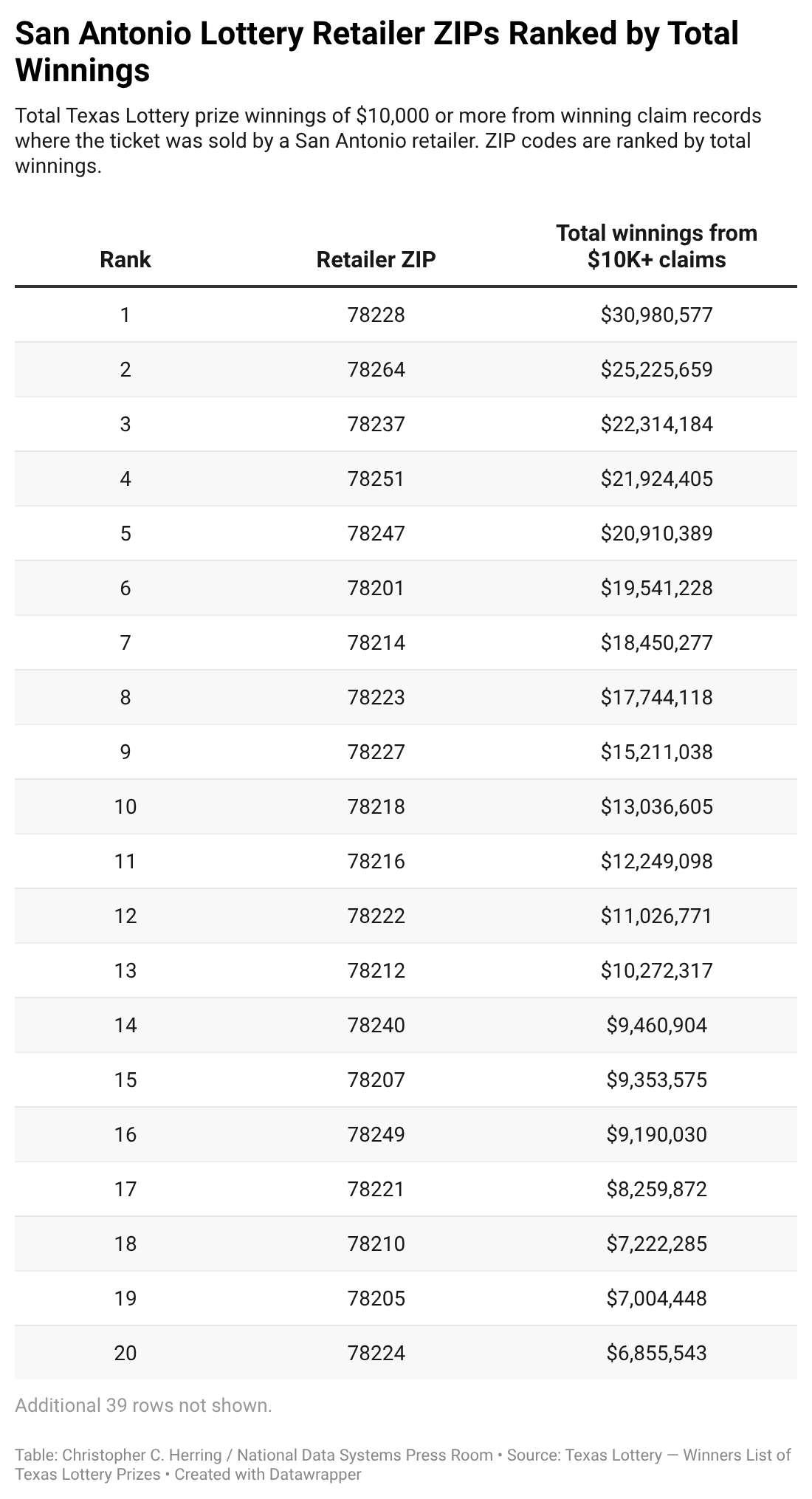
| ZIP Code | Primary Community / Area |
|---|---|
| 78228 | West Side / Jefferson / University Park |
| 78264 | South Bexar County / Von Ormy area |
| 78237 | West Side / Las Palmas / Memorial Heights |
| 78251 | Far West Side / Alamo Ranch vicinity |
| 78247 | North Central / Northern Hills area |
| 78201 | Beacon Hill / Los Angeles Heights |
| 78214 | South Side / Mission San José area |
| 78223 | Southeast Side / Highland Hills / Pecan Valley |
| 78227 | Lackland Terrace / Westwood Village / West Side |
| 78218 | East Side / Windcrest vicinity |
| 78216 | Airport Area / North Star / Uptown |
| 78222 | East Central San Antonio |
| 78212 | Monte Vista / Tobin Hill / Trinity University |
| 78240 | Medical Center / Northwest Side |
| 78207 | Historic West Side |
| 78249 | University of Texas at San Antonio (UTSA) / Northwest |
| 78221 | South Side / Mission Reach |
| 78210 | Denver Heights / Highland Park / Southtown East |
| 78205 | Downtown San Antonio |
| 78224 | South Side / Quintana Road area |
The neighborhoods surrounding these top-performing lottery retailers are also diverse in their economic and educational profiles. A National Data System analysis of U.S. Census education data found that ZIP codes 78228, 78237, and 78264 all rank below the San Antonio average in college attainment, although they differ significantly in homeownership, household income, and housing markets. Rather than pointing to a single demographic explanation, the findings reinforce that these are distinct working communities with unique histories, strengths, and opportunities.
These ZIP codes are not defined by lottery tickets—they are defined by the people who live, work, serve, and build businesses there every day. The lottery data simply provides an unexpected lens through which to view their economic activity.
The findings also illustrate the growing value of Texas' expanding open-data ecosystem. By making lottery claim records publicly available, the state allows researchers, journalists, and citizens to move beyond anecdotal stories of lucky winners and instead explore broader patterns hidden within millions of dollars in transactions. While the lottery remains fundamentally a game of chance, the geography surrounding where winning tickets are sold offers a compelling reminder that even games of luck leave measurable footprints across a city.
This study illustrates how public data can reveal patterns that were never collected for research purposes. Although the Texas Lottery records were created to administer prize claims, they also provide an unexpected window into consumer geography, retail activity, and commercial movement across San Antonio.
The analysis also demonstrates the continuity of Texas' open-data program following the transfer of Texas Lottery operations to the Texas Department of Licensing and Regulation (TDLR), ensuring researchers continue to have access to transparent public records
Retailer ZIP Code ≠ Winner's Neighborhood
The Texas Lottery records identify the ZIP code of the licensed retailer that sold the winning ticket. They do not identify where the winner lives. A customer may purchase a ticket while commuting, shopping, traveling, or working miles from home. Consequently, this analysis measures the geography of winning ticket sales rather than the geography of lottery winners.
Ultimately, the map does not tell us which San Antonio neighborhood is the luckiest. It tells us something far more interesting. It highlights the commercial corridors where people gather, where communities work, where veterans and military families have built lives, and where businesses serve thousands of customers every day. Behind every winning ticket is not simply a fortunate player, but an entire community whose resilience, commerce, and optimism continue to shape San Antonio. Sometimes hope is purchased one ticket at a time.
How This Analysis Was Conducted
This analysis examined publicly available Texas Lottery Winners List of Texas Lottery® Prizes records published through the Texas Open Data Portal. Winning claims of $10,000 or more were aggregated by the ZIP code of the licensed lottery retailer where each ticket was sold—not by the residence of the winner. Prize amounts were summed for each retailer ZIP code to identify the locations that generated the largest total value of winning tickets sold in San Antonio.
Additional community context—including housing, education, and demographic information—was derived from U.S. Census Bureau American Community Survey (ACS) data through the National Data System. These demographic measures are presented solely to describe the communities in which the retailers provide community context and should not be interpreted as evidence that demographic characteristics influence lottery participation or winning.
Editor's Note: This article is part of Texas Capital Report's continuing series demonstrating how publicly available government data can reveal new perspectives on Texas communities through evidence-based journalism. Without publicly available Texas Lottery records, this analysis would not have been possible. Subscribe Today!