
Texas-Built Intelligence Framework Supports Food Security Planning for Guatemala
Herring said. “Long-term resilience requires understanding where agricultural opportunity exists, where extension services are needed, where workforce development can have the greatest impact, and how accountability systems can help ensure resources reach the people they are intended to serve.”

National Data System Demonstrates How Data Intelligence Can Strengthen Global Agricultural Resilience
SAN ANTONIO, Texas — As international organizations continue to search for innovative approaches to food security and agricultural resilience, a Texas-developed intelligence platform is demonstrating how data-driven decision making can support more effective humanitarian planning.
National Data System, a Texas-based geospatial intelligence and decision-support initiative, recently applied its International Data Backbone framework to support agricultural resilience and food security planning efforts focused on Guatemala.
Using a governed country intelligence framework anchored to Guatemala's ISO3 country profile (GTM), National Data System developed a geographic prioritization methodology designed to identify regions where food insecurity, agricultural dependence, workforce development opportunities, and resilience-building investments intersect.
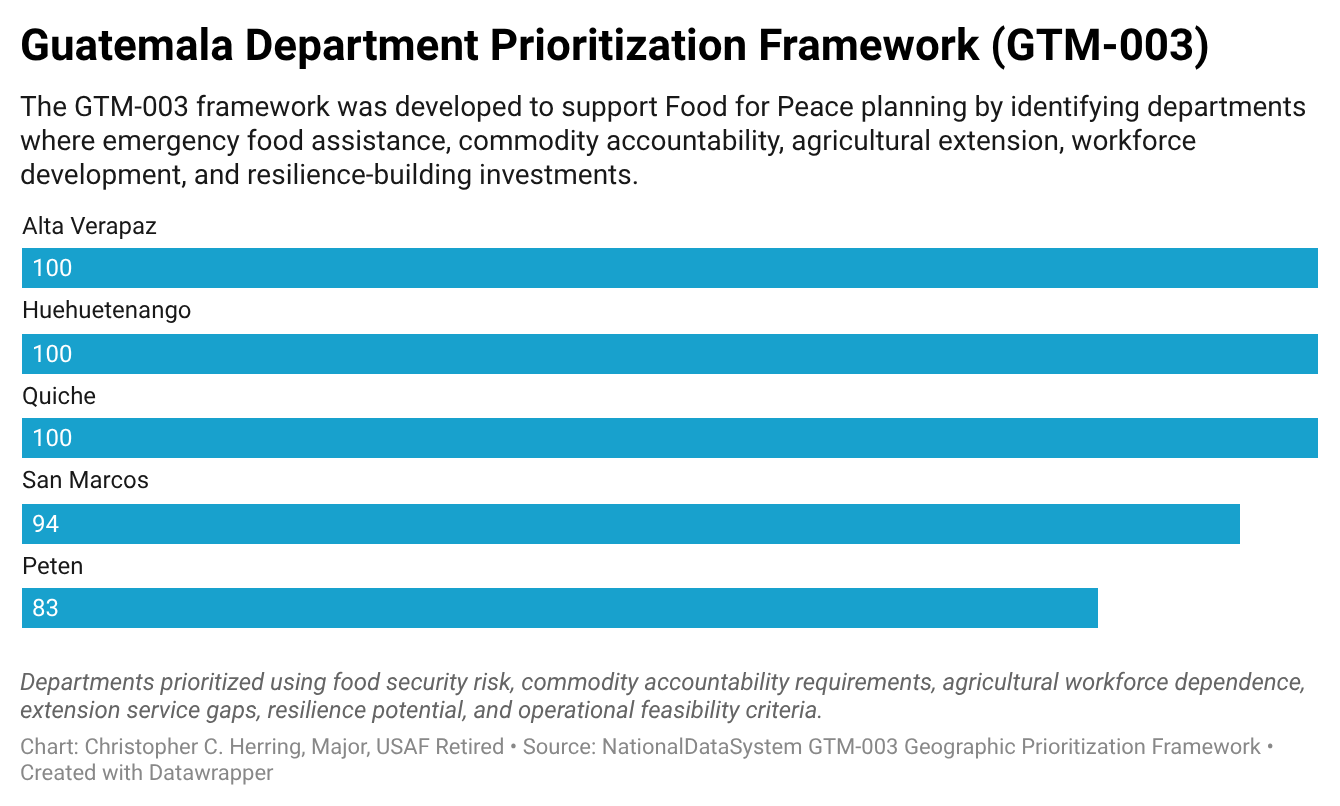
The resulting GTM-003 Geographic Prioritization Framework evaluated candidate regions across six dimensions:
- Food Security Risk
- Agricultural Workforce Dependence
- Agricultural Opportunity
- Extension Service Gaps
- Resilience Potential
- Operational Feasibility
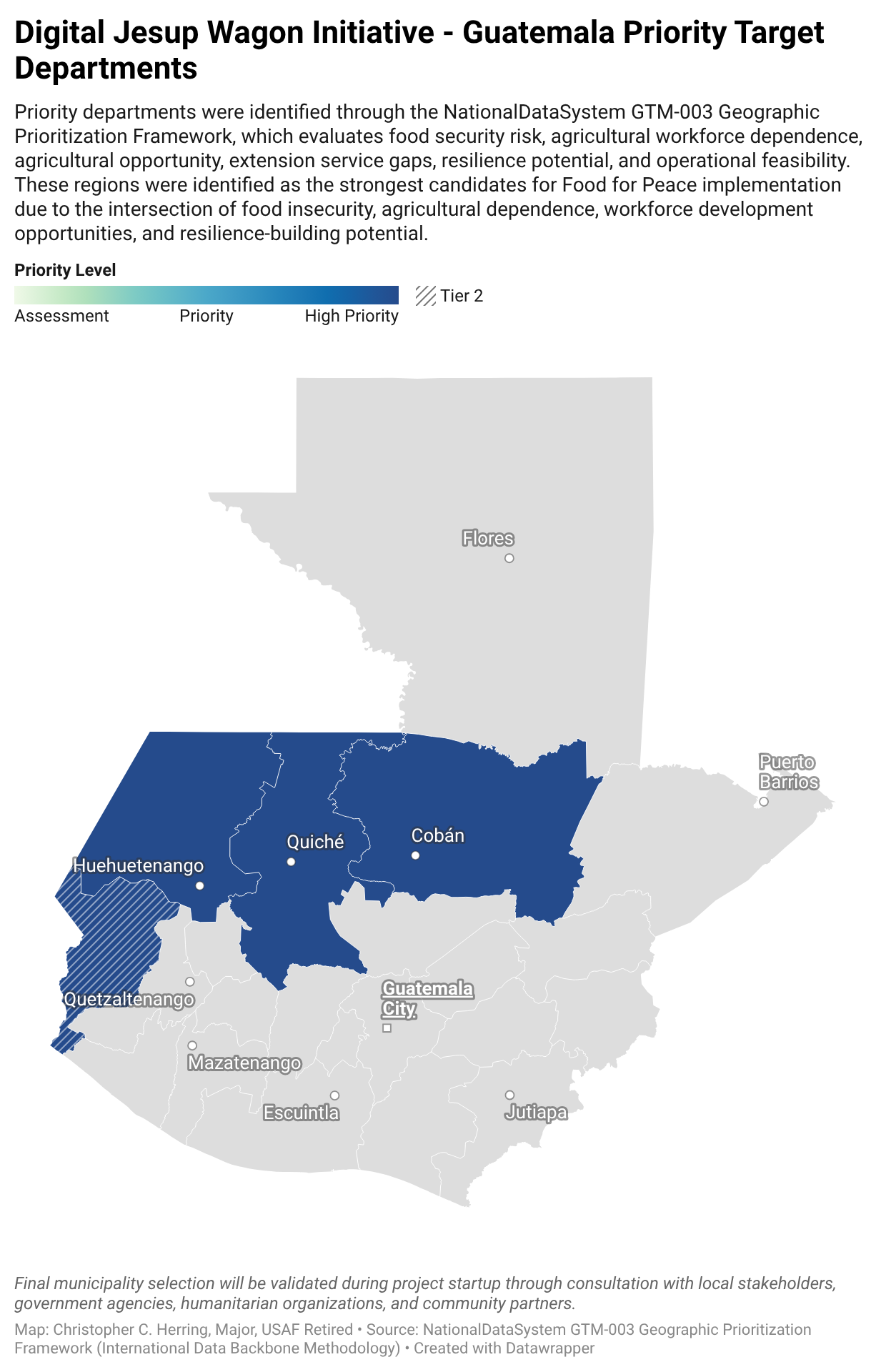
The framework identified Alta Verapaz, Huehuetenango, and Quiché as the highest-priority implementation areas, with San Marcos identified as a secondary expansion candidate.
Geospatial Assessment:
According to NationalDataSystem founder Christopher Herring, the effort demonstrates how intelligence infrastructure can be applied to humanitarian planning and agricultural development initiatives.
“Food assistance is only part of the equation,” Herring said. “Long-term resilience requires understanding where agricultural opportunity exists, where extension services are needed, where workforce development can have the greatest impact, and how accountability systems can help ensure resources reach the people they are intended to serve.”
The Guatemala effort also highlights a broader trend in international development toward data-driven accountability and performance measurement.
NationalDataSystem's approach incorporates commodity accountability, beneficiary intelligence, food security monitoring, agricultural resilience measurement, and monitoring, evaluation, accountability, and learning (MEAL) frameworks into a single decision-support environment.
The initiative was developed in support of a broader Digital Jesup Wagon concept inspired by the historic agricultural outreach model pioneered by Booker T. Washington and George Washington Carver at Tuskegee University.
The modern Digital Jesup Wagon model combines emergency food assistance, agricultural extension, workforce development, accountability systems, and agricultural intelligence to strengthen food security while reducing long-term dependency on external assistance.
While the Guatemala initiative remains in the proposal stage, the project illustrates how locally developed intelligence systems can support international agricultural development and humanitarian planning efforts.
NationalDataSystem's International Data Backbone currently supports geographic intelligence, economic indicators, resilience metrics, trade intelligence, and opportunity analysis across multiple geographic levels, creating a reusable framework for future agricultural development, food security, and resilience-focused initiatives.
As global food security challenges continue to evolve, initiatives such as GTM-003 demonstrate the growing role of data governance, geographic intelligence, and accountability systems in supporting effective and measurable development outcomes.