Did Texas Owe Black Businesses More Than a Blank Map?
Texas instituted the HUB program in 1991 to increase opportunities for businesses owned by minorities and women in state procurement and contracting, and that state agencies were to make a good-faith effort to utilize HUBs in construction, services, and commodities purchases.

Austin, TX - For decades, Texas acknowledged disparities in state contracting and created the Historically Underutilized Business (HUB) Program to expand opportunity. Today, many of the program's goals have been removed or revised. The question is no longer whether the program changed—it is whether the state's legal and moral obligations changed with it.
This investigation follows the historical evolution of Texas' Historically Underutilized Business (HUB) Program, examining official records, procurement reports, legislative changes, and historical participation data to understand what changed after the 2026 policy revisions.
What Texas’ Own HUB Reports Showed Before the 2026 Changes
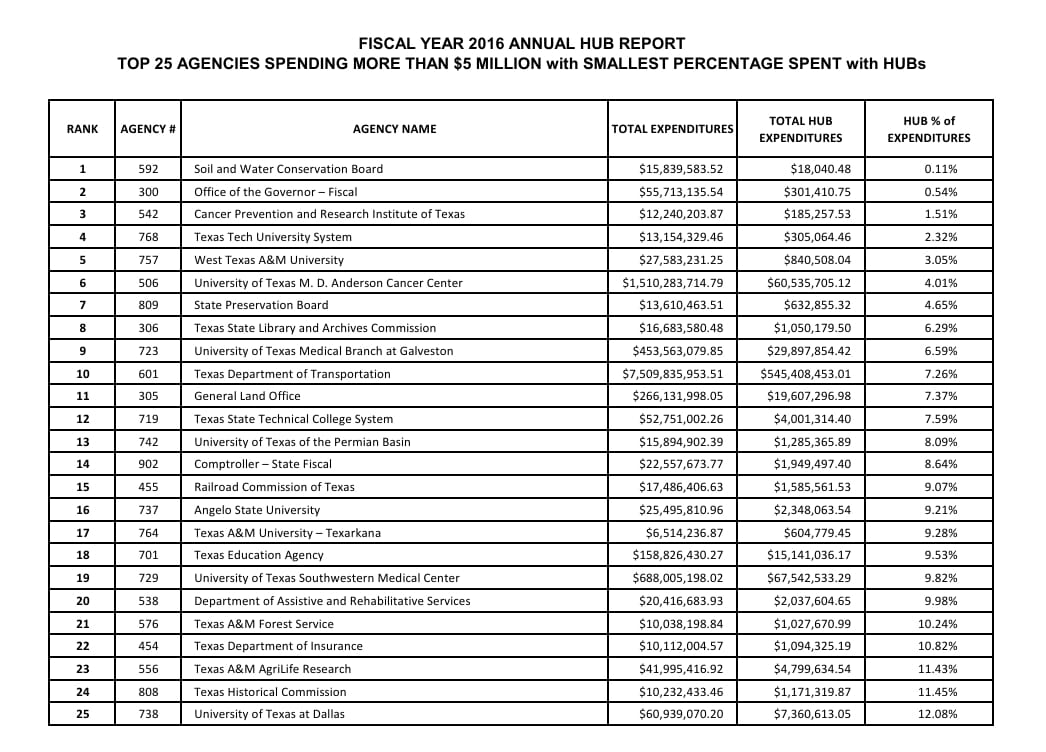
Major agencies still spent very little with HUBs
Some agencies spending more than $5 million reported HUB participation below 1%.
Texas tracked category-specific HUB goals
The state measured HUB participation across construction, services, and commodities.
Women-owned HUBs received approx. 44.5% of HUB awards
Women-owned and Hispanic-owned HUBs received the largest shares of HUB expenditures.
The before-and-after maps of Black-owned business visibility in the Texas HUB program raise a legal question, but also a moral and economic one: if Texas created a procurement program to address documented disparities, set statewide utilization goals, watched Black businesses remain far below parity, and then allowed the program’s race- and gender-conscious framework to be removed or replaced without the Legislature first declaring the disparity solved, what exactly does the state owe? Does it owe money? Does it owe restored certification? Does it owe a new disparity study? Does it owe stronger enforcement? Or did the old HUB law contain so little force that unmet goals became politically meaningful but legally toothless?
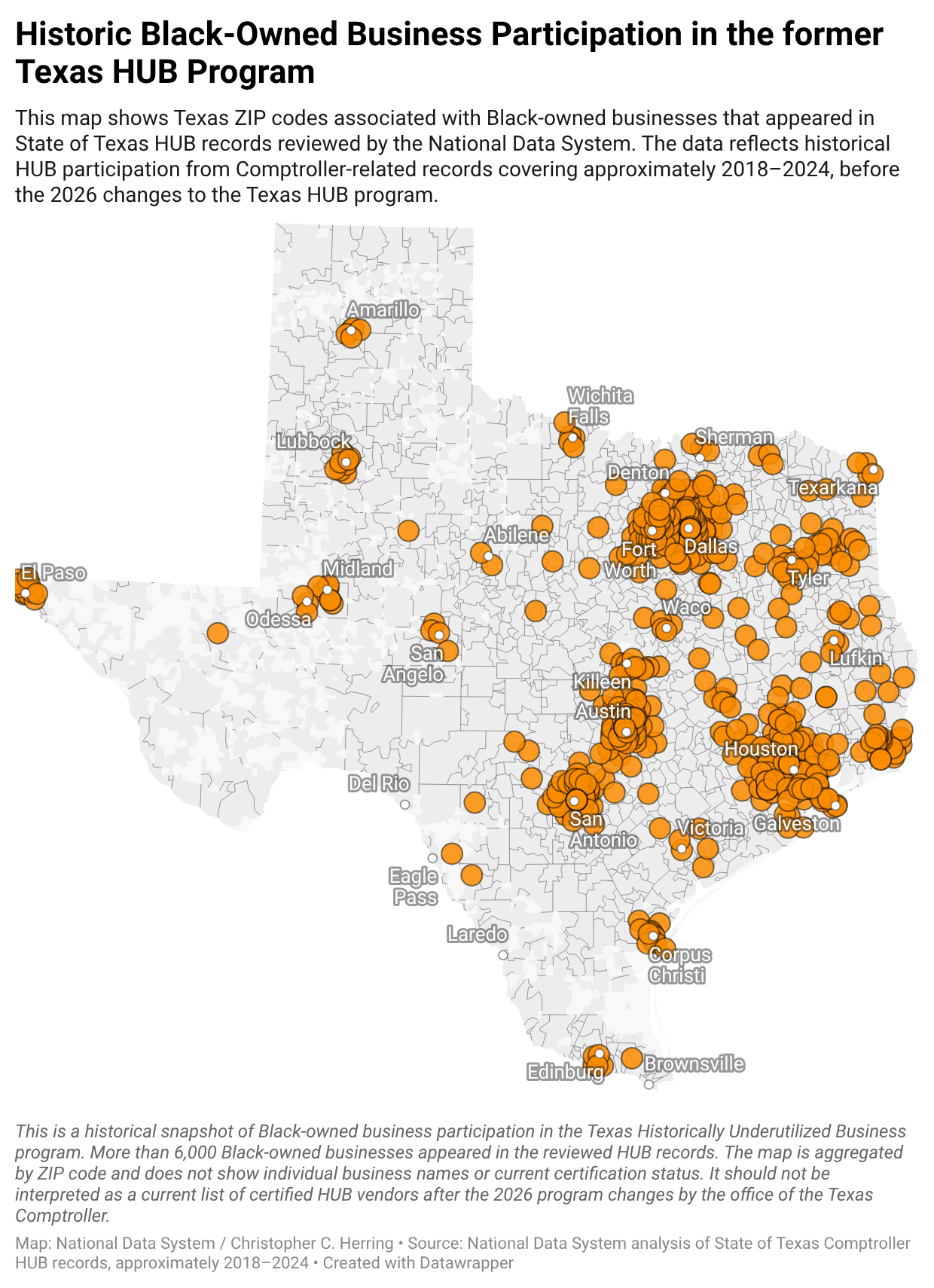
BEFORE: More Than 6,000 Black-Owned Businesses
Historical Texas HUB participation records, approximately 2018–2024
The Program's Original Purpose
The answer begins with the nature of the Texas HUB program itself. The program was not a hard quota system. The state’s own materials described statewide HUB goals as annual utilization goals based on expenditures by procurement categories for state agencies and universities, including 11.2% for heavy construction other than building contracts, 21.1% for building construction, 32.9% for special trade construction, 23.7% for professional services, 26.0% for other services, and 21.1% for commodities. Those were goals, not automatic awards. The same materials explain that Texas instituted the HUB program in 1991 to increase opportunities for businesses owned by minorities and women in state procurement and contracting, and that state agencies were to make a good-faith effort to utilize HUBs in construction, services, and commodities purchases. The program also allowed HUB subcontracting plans for contracts above $100,000. That structure matters because it shows the law was designed to create visibility, outreach, good-faith effort, and opportunity, not guaranteed contracts.
What the Historical Records Show
The 2009 State of Texas Disparity Study gave the program its legal and policy foundation. The Comptroller’s materials said the office retained MGT of America to determine whether there was a compelling interest to continue a narrowly tailored HUB program, as required by the U.S. Supreme Court. The study was intended to review the state’s HUB utilization and evaluate program-development options. The same materials stated that the 2009 study confirmed the need for continuing the statewide HUB program, citing statistical disparities by race, ethnicity, and gender in current HUB utilization, especially in prime contracting; disparities in the private marketplace; disparities in firm earnings even after controlling for capacity-related factors; and anecdotal testimony of disparate treatment from business owners.

That finding is important because it means the HUB program was not created out of nostalgia or symbolism. It was created and defended through the language of disparity, evidence, legal tailoring, utilization, and opportunity. The state’s FAQ materials described minority-owned business enterprises as businesses at least 51% owned and controlled by African American, Hispanic American, Asian American, or Native American owners, and woman-owned businesses as at least 51% owned and controlled by non-minority women. The same FAQ said the State of Texas sought to maximize utilization of Texas-based women- and minority-owned businesses through the HUB program. It also described the program’s mission as encouraging and effectively promoting HUB utilization by all state agencies and promoting full and equal business opportunities in accordance with goals based on the State of Texas Disparity Study.
State Agencies Were Expected to Participate
But there the accountability problem emerges. A goal without a remedy can become a public promise without legal teeth. A good-faith requirement without consequences can become a reporting exercise. A disparity study without sustained enforcement can become a historical document. If an agency failed to meet HUB goals, did Black businesses have a direct claim for damages? Generally, the answer is not obvious and likely not automatic. HUB goals were aspirational and tied to good-faith efforts, reporting, solicitation, certification, and subcontracting-plan procedures. They were not written as a simple damages formula saying that if Black businesses received 1.22% of spending when parity required more, the state must pay the difference. That does not mean there was no harm. It means the legal mechanism for remedy may have been weak, indirect, or dependent on administrative enforcement, legislative oversight, declaratory relief, injunctive relief, or procurement challenges rather than automatic compensation.
Outreach Beyond Certification

Historically, the President of the Texas Association of African American Chambers of Commerce, Charles O’Neal’s 2016 remarks at Black Business Day at the Texas Capitol sharpen the point. Speaking before Governor Greg Abbott addressed the group, O’Neal said plainly, “We’re here because the State of Texas has been unresponsive to your needs.” He continued by saying that despite efforts to increase utilization of ethnic minority-owned businesses, “black businesses have earned less than all other groups.” Then he added, “It’s painful. And we think it needs redress.” Those are not abstract words. They are a contemporaneous statement from Black business leadership that the state’s procurement system had not delivered equitable results even after decades of policy effort.
O’Neal also gave the economic context that makes the failure more serious. He said Texas was approaching 15% Black population and that the most recent business-owner survey reflected a dramatic increase in Black-owned businesses in the state, from about 175,000 to about 247,000. But he then said, “What we’ve not experienced is a corresponding growth in revenue. Our businesses are flatlining.” He added that of 247,000 Black-owned businesses, fewer than 10,000 had employees. That distinction is essential. Business formation had grown, but business scale had not. Visibility may have existed, but revenue did not follow at the level expected. A state can point to a growing number of registered or certified firms, but if those firms are not receiving contracts, building revenue, adding employees, or scaling into larger procurement roles, the policy outcome remains incomplete.
The hardest number in O’Neal’s remarks was the utilization figure. He said that in the most recent budget, out of $17 billion, only 1.22% was spent with Black-owned businesses. He then said, “We believe that growing the state’s utilization rate at this point… gives us significant advantage in the marketplace.” And he asked, “Shouldn’t we be able to maximize utilization, even at rates of other groups.” That question is the center of this article. If Black businesses were at 1.22% of a $17 billion spending environment after decades of a program designed to increase utilization, what conclusion should the public draw? That Black businesses lacked capacity? That agencies failed to seek them? That prime contractors failed to include them? That the goals were too weak? That reporting did not translate into enforcement? Or that the program needed strengthening, not removal?
The 2025-2026 Policy Changes
Race-Based HUB Categories Removed from the Reporting Framework
2025-2026 Comptroller Policy Changes
The state’s later actions make that question urgent. In 2025 and 2026, the Comptroller’s office moved to suspend new HUB certifications, conduct legal review, remove information from the website, and restructure the program. Reporting provided by KXAN described the HUB program as one that provided exposure to minority- and female-owned businesses in state procurement. KXAN reported that Acting Comptroller Kelly Hancock said new HUB certifications were suspended and quoted him as saying, “Businesses deserve a level playing field where government contracts are earned by performance and best value — not race or sex quotas.” The same report quoted State Sen. Royce West, one of the architects of the program, explaining that the HUB program was created to ensure minorities and women were included in the mix to become government contractors.
1993
Texas HUB Program Established By Legislation
↓
2009
State Disparity Study
↓
2016
Agency Utilization Goals
↓
2017
Agency Outreach Agreements
↓
2019–2024
Historical Business Participation
↓
2025-2026
Major Policy Changes by Acting Comptroller
That framing creates two competing theories of fairness. One theory says fairness means eliminating race- and sex-based classification from public procurement systems. The other theory says fairness cannot be measured only by removing categories; fairness must also ask whether the market has actually become equal. If Black businesses were still receiving far less than parity before the program was changed, then the removal of the category may make the system appear neutral while making disparity harder to track. A race-neutral form does not automatically create a race-neutral market. A blank map does not prove equality. It may simply show that the public category has disappeared.
The legal issue is also complicated by the difference between statutory authority and program outcomes. If the Comptroller had statutory authority only to administer the HUB program, certify eligible businesses, maintain the directory, provide consulting services, assist agencies with good-faith efforts, and report initiatives to the Legislature, then a unilateral restructuring of the program raises a serious separation-of-powers question. The state’s FAQ materials described the Comptroller as the administrator and maintainer of the HUB program, responsible for reporting HUB initiatives to the Legislature, certifying eligible businesses, maintaining a current list, consulting with state agencies and HUB coordinators, and assisting with good-faith effort requirements and analysis.
That is why the question “does the state owe Black businesses?” has more than one answer. In a strict damages sense, the old HUB program may not have created an automatic check owed to Black businesses every time goals were missed. The law appears to have relied heavily on aspirational goals, reporting, good-faith efforts, certification, solicitation requirements, and subcontracting-plan review. Those tools create pressure, but not necessarily a private damages remedy. In that sense, critics may say the law lacked teeth. But in a broader legal and civic sense, the state may still owe something significant: it may owe enforcement of the statutory framework until the Legislature changes it; it may owe transparency about whether goals were met; it may owe a new or updated disparity study before dismantling the remedial structure; it may owe an explanation of how parity was achieved, if the state claims the remedy is no longer needed; and it may owe restoration or judicial review if an executive official exceeded statutory authority.
This distinction matters because the old program’s weakness may have been precisely that it required good-faith effort without sufficient consequence. If a state agency failed to meet HUB goals, did the agency lose funding? Were contracts invalidated? Were procurement officers sanctioned? Were prime contractors penalized for failing to include HUB firms? Were agencies required to produce corrective plans with measurable future targets? If the answer to those questions was usually no, then the problem was not that the HUB program had too much power. The problem may have been that it had too little enforcement power to achieve the parity its own disparity findings justified.
O’Neal’s remarks support that interpretation. He did not argue that the HUB framework should be discarded. He argued that the state had been unresponsive, that Black businesses were underperforming in revenue, that utilization was too low, and that state agency engagement was necessary. He described TAAACC’s work with agencies across Texas, including professional-service roundtables and Memorandums of Cooperation with 16 or 17 state agencies that traveled across the state to meet businesses where they were. That is evidence of implementation infrastructure. It suggests that Black business leaders were not waiting passively for contracts. They were building outreach systems, working with agencies, and asking the state to perform better.
That is why the maps matter. The first map shows that thousands of Black-owned businesses had been visible in the reviewed Texas HUB records. The second map shows what happens when the Black-owned category is no longer displayed. But the blankness should not be confused with resolution. If the historical problem was underutilization, then the policy question is not whether the label remains. The policy question is whether Black businesses are now receiving fair access to contracts, revenue, and scaling opportunities. If they are not, then removing the category may reduce accountability rather than improve fairness.
The state can argue that constitutional law has changed and that race- and sex-conscious programs must be reviewed carefully. That is a real argument. The state can argue that public contracts should be awarded based on performance and best value. That is also a real principle. But neither argument answers the utilization question. Performance and best value do not explain why Black businesses were at 1.22% of $17 billion in the period O’Neal described. Constitutional caution does not explain why a disparity study that once confirmed continuing need should be treated as irrelevant without a public showing that disparity no longer exists. Legal risk does not erase economic history.
So does the state owe Black businesses? It may not owe automatic damages under the old HUB goals. But it owes the public a reckoning. It owes an answer to whether the disparity identified by the 2009 study was ever cured. It owes an explanation of whether Black-owned businesses reached meaningful participation before their category was removed from the displayed framework. It owes transparency about which agencies met goals, which failed, and what happened when they failed. It owes clarity about whether the Comptroller had authority to alter the structure of a legislatively created program without the Legislature first rewriting the statute. And if the old law had no teeth, then the Legislature owes an honest debate about whether Texas ever intended the HUB program to produce parity or merely to report aspiration.
That is the uncomfortable truth. A goal without enforcement can become a shield for inaction. A disparity study without follow-through can become evidence of knowledge but not remedy. A certification program without sufficient contracting outcomes can create visibility without economic transformation. And a policy change that removes the category before parity is reached can turn underperformance into invisibility.
What the Blank Map Represents
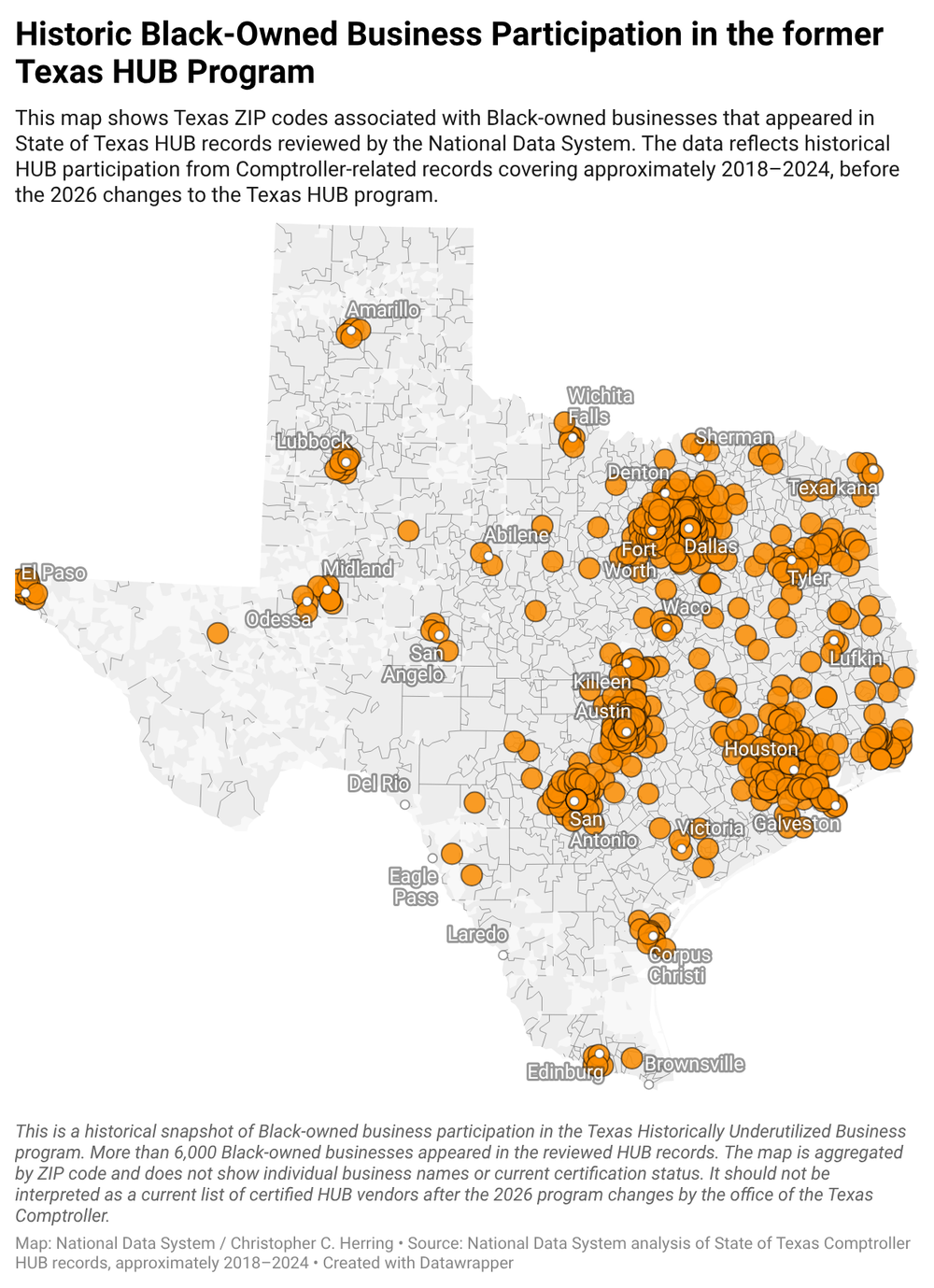
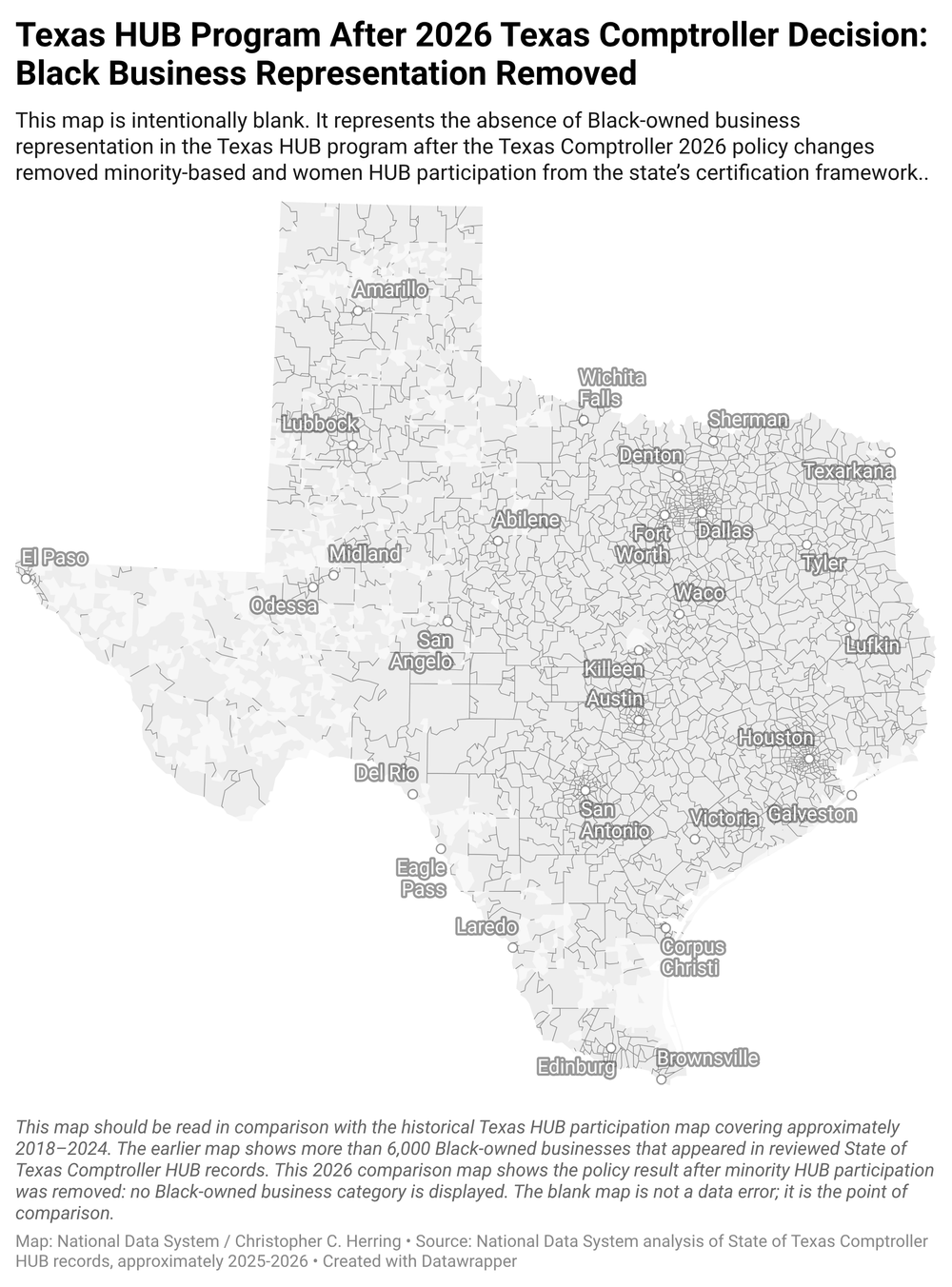
The next question for Texas is not whether the state can change a program. Programs can be changed. The question is whether the state can change a disparity-remedy framework without showing that the disparity has been remedied. The maps suggest the answer should not come quietly. The historical map shows a statewide Black business participation base. The blank map shows what the public sees when that category is removed. Between those two maps lies the question Charles O’Neal asked in different words in 2016: should Black businesses not be able to maximize utilization at least at the rates of other groups? Until Texas can answer that question with evidence, the blank map should not be treated as reform. It should be treated as an accountability gap.
Continue the Investigation
This investigation documents the historical evolution of Black-owned business participation in the former Texas HUB Program and the changes to the reporting framework after the 2026 policy revisions. These companion investigations examine the legal authority behind those changes and the legislative debate that preceded them.
The Legislature Makes the Law. The Comptroller Administers It.
Who has the legal authority to change the HUB program? This investigation examines the difference between legislative power and administrative implementation, and why that distinction became central to the HUB debate.
Read Investigation →Before the Lawsuit. Before the Review. Before the Controversy.
Long before the 2026 policy changes, Texas lawmakers were already debating the future of the HUB program. This investigation traces the legislative discussions that laid the groundwork for today's controversy.
Read Investigation →This investigation documents how the historical representation of Black-owned HUB businesses changed following the 2026 policy revisions. Whether those changes altered legal obligations, procurement opportunities, or the intent of the HUB program is explored further through legislative history, administrative actions, and related reporting.